Friday, November 28, 2008

Around Siggiewi


I saw the ad in the Times of Malta for a new series of cultural tours launched by the Malta Council for Culture and the Arts.  I cut out the ad and it sat around on my kitchen table for a few days until I was going up to Valletta for the lunchtime concert at St Catherine's.  By then, it was past the Wednesday deadline for booking but I went down to the office in Republic street anyway to find out more about the programme.  When I walked in through the big doors that took up the whole street frontage of the converted townhouse of the office building, there was no-one at the reception desk so I wandered up the marble stairs and was greeted at the top of the stairs by a young man poking his head out of a door.  I explained why I was there.

"You're not too late," he exclaimed, "we've put on extra buses to cope with the demand and there are still a few places left on the last bus."  Another young man inside the office started telling me with enthusiasm that we were going to be shown around the inside of the PM's residence, "even the bedrooms!"

"I hope they won't still be in bed then," I muttered, wondering if I would regret putting my name down for what was starting to sound like a reality TV nightmare.  Anyway, I showed them my KartAnzjen that I have just received through the local council process using my Malta ID card and I got a reduced price.  Playing the old people's card here is magic and gets me 23 cent travel on any bus, anywhere.

So on Sunday, I got an early bus up to Valletta where I had to pick up the coach at the statue of Independence in Floriana.  When I arrived, there were six buses lined up and I was early enough to get on the first one.  Everyone else on the bus was Maltese and so the commentary was given in Malti.  Later, a friendly woman sitting next to me spoke to the guide about the fact that I couldn't speak Malti and she started to give two commentaries using both languages.  I continue to be humbled by this social skill that Maltese people have of slipping easily between the two languages.  But speaking Malti is still a symbol of Maltese pride and independence and it is the preferred language of everyday social interaction when everybody can speak it.  In my posts about the pre-history of Malta I talk about the continuing tension in choice of language between Malti, English and Italian.

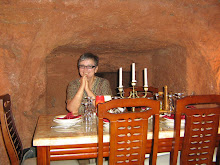
First we visited Verdala palace.  There's a photo of the outside of the palace/castle heading up one of my earlier posts, and the photo that heads this one is of one of the amazing vaulted ceilings.  The ceilings and stairs were probably the most impressive aspect of this building that is now the residence of the PM and used for entertaining important visiting dignitaries.  Other rooms had very high ceilings with timber beams and the staircase was oval rather than circular and had lovely stone arches.

Next we went to two old churches in Siggiewi.  Providence church has a lovely domed ceiling and in the sacristy there is a red covered copy of a bible in Malti.  It is a small church and when we were all inside, it was a bit crowded so I didn't really take in much.  The other church we visited was medieval and has recently been restored with accolades from Din l-Art Helwa, a local NGO who are particularly concerned with Malta's heritage.  I loved the way it had been restored as a ruin rather than attempting to rebuild.  The ancient parish church had been pulled down to make way for a new church which was never built on this site.  Two interesting twisted Corinthian pillars have been reset on either side of an entrance into the old chapel where now stone carvings are on display.  To get to the site, we used a walkway through an old orange grove.

Our  final visit for the morning was to the Inquisitors Palace at Girgenti.  I have mentioned the Inquisitors palace at Birgu in a previous post.  The one at Girgenti was purely residential rather than also hosting the operations of the inquisition as it did in Birgu.  Nowadays it is the summer residence of the PM and I liked the use of the work of modern Maltese artists in the bedrooms.  For the most part, it is fairly austere as palaces go but the views down through the lovely valley are great.  When we came out of our tour into the garden, we were offered an enormous bread roll for lunch with a choice of 7-up or Coke which I devoured with relish as we walked back down the drive to our bus!

The idea behind this series of cultural tours is to enhance understanding of local culture and heritage.  It is particularly aimed at Malta residents rather than tourists and it gives access to sites that most tourists would not see.  The next tour in December is to Birgu with a trip across to Senglea in a traditional luzzu and I'm planning to book that before the deadline!

Wednesday, November 26, 2008

Because it's so small


One of the things I love about Malta is that it is small.  I don't need a car here because I can walk everywhere around the village.  Shopping is done every day so it's fresh and I can carry it easily by hand.  If I want to go further afield as I usually do several times a week, I can catch a bus to anywhere on the island.  If I take a book with me, or the Times of Malta that is saved for me most days by the local newsagent, then the unpredictable wait between buses is an opportunity.  So far, if I am pressured for time or I have to go home after the last bus leaves, I have been able to find someone with a car who is going in my direction.  It is a good system with the added satisfaction of reducing my footprint on the planet!

Another good thing about smallness is that it is easier to see the complexity of the links between everything that makes up the whole.  I seem to have moved into a space where I am avidly gathering all the information I can find about Malta.  The word 'Melitensia' has started to come up.  It means things to do with Malta.  The local librarian used it the other evening to describe my area of interest.  When I went slightly wild at the book fair in Valletta a couple of weeks ago and bought too many books on Maltese history and culture, one of the book stall owners used the word to encourage me to go to browse his shop collection.  So now I can put that label on my current interests.  

I use that as an example of a broader picture that is emerging for me.  I think it is to do with the cliche about thinking global but acting local.  As I gather the small, fascinating facts about Malta from many different sources in the course of my everyday life, I also seem to be gaining more of a gut understanding about global issues.  Another example is the final session last night of the course I have been doing in Mosta, 'Wildlife and Habitats of the Maltese Islands'.  The session was about legislation and was somewhat inclined towards long lists of conventions, agreements and decisions that have relevance for EU and for Malta.  Some things I had heard of before but in an academic sort of way - Bonn, Berne, Rio, Ramsar.  I had also heard words like ratification bandied around but hadn't really understood the significance.  Last night when the lecturer mentioned in passing that Malta had been taken to the EU court because it had failed to make enough progress in dealing with the issue of the hunting of migratory birds, I could link that in my mind with the gunshot that has woken me most mornings for the first few months here, the little hunting bird tables around most of the fields when I am walking, the local librarian talking about how her husband gets very depressed if he can't hunt, the pressures on the landscape of a small, crowded island.

Today I am going for another Ramblers walk, this time around Zebbiegh and Mgarr visiting the ancient temples of Skorba.  I started this post thinking I would talk about the cultural tour I went on last Sunday around Siggiewi but I got side-tracked by smallness.  So Siggiewi will head up my next post and for this one, I'll find a photo and post so that I allow enough time for the bus to Mgarr. 

PS  The photo was taken when I was exploring around Senglea, one of the ancient cities around Grand Harbour


Monday, November 24, 2008

Dingli Cliffs and saline marshlands


This morning I got caught in a downpour as I went for my walk.  I set off to find the Marsaxlokk remnant wetland I heard about in the Wildlife and Habitats course that I am doing in Mosta.  It is in a corner at the opposite end of the bay from where my flat is and I wasn't aware of it until it was mentioned as one of the important remaining areas of saline marshland.  It is difficult to access as it is fenced off from the beach and also from the road but the fence is down in one spot and there is a clear path through, probably where fishermen have accessed the beach.  It is somewhat degraded with rubbish but it was good to see it in the rain and it still supports several species of dune plants.  

The downpour also helped me to understand some more about the rainfall patterns in Malta.   When it rains here, mostly in the winter months, the downpours are short and heavy and the run-off pours down the valleys to the sea bays.  Marsaxlokk is one of the seafront villages at the bottom of a valley and now that it has been built up, the rainwater pours down the roads and floods briefly on the front.  In some other areas such as Msida, this is a problem and often traffic is prevented from getting through for a few hours until the water clears.  It doesn't seem to be more than a temporary inconvenience in Marsaxlokk as the water pours across the front and into the sea without too many obstructions.  But I can see how in the past, the saline marshland would have been extensive and an important part of the ecology of the area.

This post is about walking around Dingli cliffs.  The picture at the top is of Verdala castle taken as we were walking towards Buskett gardens.  As I discovered on my cultural tour yesterday with the Department of Arts and Culture, Verdala was of course built by the knights as a residential fortification and is now the winter residence of the Prime Minister.  The knights also planted the forests around to support their hunting and although the British later removed a lot of the trees to make way for agriculture and the orchards that still cover much of the valley, this is still the most heavily wooded area of Malta.

The walk from the lovely village of Dingli to Busketto gardens and then along to the Dingli cliffs was another in the programme organised by Malta Ramblers Association but this time it was mid-week.  The meeting place was St Mary's parish church in Dingli village so I had to catch the 81 bus from Valletta and just got there on time.  There were fewer people than on the weekend walk through Wied Garnaw but still over 60 walkers set off with an enthusiastic German guide to lead us.  We walked out of the village past the mandatory village statue of a local celebrity - this time a beautifully worked bronze of a poet, Charles Ebejer, sitting reading in a chair.

We walked along country lanes past a well maintained and signed local park towards Busketto. The guide pointed out the ancient cart ruts that can be made out across a slight valley on the slope of a rocky cliff near to an old quarry.  There was some debate about going through the forest as this would add about half an hour onto the timing for the walk and the evenings are drawing in now but most people wanted to walk through and I was glad that we did.  The forest here is lovely with lots of native trees such as Holm Oaks and Mediterranean pine as well as groves of fruit trees such as oranges.

Our time in the forest meant that we were walking along the cliffs just before sunset.  The sea was flat calm and it was stunning.  Just enough cloud to redden the horizon and the dramatic fall of the cliff face.  We came to a small chapel on the edge of the cliff with about ten minutes before the sun disappeared and we all found rocks or the verandah of the chapel to sit and watch.  At this point, the cliff edge drops down to some terraced fields that are beautifully tended and I spotted on the rocks at the top some of the plants I have been learning about in the course I am doing.  It was a magic moment.

It was after 5.00pm when we got back to Dingli and I was now pushed for time to get to Mosta for 5.30 for the evening class on insects, arachnids and crustaceans.  So as the walking group was rounding things off, I asked if anyone was driving past Mosta and sure enough someone was going to visit their daughter who lived there.  I arrived at class just as everyone was going in to the lecture room and the exhilaration of the walk carried me through a rather dry couple of hours on insect classification!

Saturday, November 22, 2008

Getting around


I've been traveling away from Oz for 6 months now and this is my 50th post!  There have been reports of destructive storms in Brisbane this week, but my friends there tell me that it isn't as bad as it might be painted in the international press.  My brother in England tells me that he's just finished the apple harvest before the frost arrives and his garden is inundated with field mice, moles and squirrels.  My other brother in Scotland tells me he is resigned to another windy and cold winter on his boat.  

Here in Malta, the nights are getting cold and I have bought myself fleecy pyjamas with Minnie Mouse all over them, and a duvet so I am snug.  Today is windy but the sunny days here are still warm and the change of season has greened up the fields and natural habitats so the whole island looks fresh and lovely.  I have lampuki (local fish) bones bubbling on the stove to make fish stock and mixed beans are soaking to make minestrone soup.  All is right with my world!

The photo above is the inside of a local bus taken yesterday on my way back from Paola where I had been to find out about my local medical centre.  Most of the buses here have little shrines and sayings or jokes written up near the driver's cabin with his red ticket machine.  But I loved this one with Mary in the middle and bobbing Hollywood starlets on either side!

In my next post I'll tell the story of a ramble around Dingli cliffs but for now, I want to add a postscript to my previous post about the pressures on the Maltese landscape.  When I walked over to the meeting place for the Wied Garnaw ramble, I walked up through the valley between Marsaxlokk and Birzebbugia.  The country lanes through here have become a regular route for my morning walks and after hearing about the conflicting uses of the countryside, I decided I would try and see if there was a circular route coming back down through the valley towards Birzebbugia.  I have already discovered the walking route along the cliff between Marsaxlokk and Birzebbugia to complete the circuit.  I walked up through the valley and found what looked like a country lane going in the right direction.  The road went through a tiny hamlet and down through rubble walls towards a vast scrapyard.  A truck passed me squashing me against the rubble wall and then stopped blocking off the road so that I had to again squeeze past it.  As I came out on the other side, there were car bodies and scrap iron spilling out of the surrounding fields and onto the country lane leaving only a narrow winding path through.  Three men were working on a car body at the side of the path and as I came up I asked politely if I could go through here.  One said 'yes', another said 'No'.  So I carried on walking through the jungle of scrap metal until I came out on the main road down into Birzebbugia.

I have thought about it a lot since.  There is clearly a need for scrap metal yards in Malta but it is tragic to see scarce agricultural land used for this purpose and spilling onto the public right of way.  When I talked with some of the participants in the Wildlife and Habitats course I am doing in Mosta, I discovered that one of the women lives in Birzebbugia (she now gives me a lift home which is a godsend!) and she told me that the Birzebbugia local council were taking the scrap yard people to court but it was very difficult since it was private land.  In such a small island where everybody knows everybody else and people have been traditionally self-sufficient, it is a hard task to change an established use.  I'm not about to join the letter-writing brigade but I would like to think of some way in which I might contribute to the resolution of this issue.

My next post is about the area around Dingli village where the local council appears to be doing well in managing the varied uses of the land in the area.

Friday, November 21, 2008

Back to earth


In my last posts about the pre-history of Malta and Gozo, I got a bit caught up in the academic side of things and the writing became long-winded as a result!  This post will be about getting back to normal and outlining my next series of posts.  The photo that heads the story is of some local council tree-planting that I noticed on the first of the walks that I have been on over the past few weeks.  The trees are locally endemic and the location is Wied Garnaw, a valley running down from Luqa past Tarxien to the coast at Marsascala.

Over the past few weeks I have been looking into the natural history of Malta.  I've joined the Malta Ramblers Association, contacted Geographic Malta, and have enrolled in an evening course being held in Mosta on the habitats and wildlife of Malta and Gozo.  The latter is organized by the Institute for Environmental Studies and I'll write about that after I've completed the course towards the end of next week.

Today's post is about Wied Garnaw where I first started to pick up on the pressures that the Maltese countryside is under.  My landlord put me in touch with the Malta Ramblers Association who lead short walks on Saturdays and Wednesdays at different locations around the island.  On their programme, they list meeting places and times and everyone turns up.  A few longer walks are restricted and have to be booked a week or so beforehand.  In December, there is a length of Malta walk that I would love to go on and I will try and get my email in as soon as the bookings open to get into the small group.  On the open walks, over 100 people usually turn up.

The meeting place for the Wied Garnaw walk was the parish church at Luqa.  Every small village has its parish church and it is a central meeting place for everyone.  I decided to walk over from Marsaxlokk through the fields to Zejtun and then on through Ghaxaq and Gudja.  It took me about an hour and a half but on the way I met a woman whom I had first talked with when we were both buying vegetables at the cart in Marsaxlokk soon after I came here two months ago.  At that time she told me how to cook stuffed aribaldi (round zuchinis), a dish that has become one of my staples.  This time, we chatted about Malta geographic, an organisation that I hadn't come across before, and mothers-in-law.

When I arrived at Luqa with about five minutes in hand, there were already well over 100 people waiting in small groups and chatting in Malti.  The walk had been programmed as 'Four Santa Marjas' as there are four churches in the area dedicated to Saint Mary but the planned leader couldn't make it and instead the walk was lead by a women from MEPA, the government's Environmental Planning section.  She advised us that we would be going on a circular walk through Wied Garnaw and she was going to focus the walk on the conflicts and tensions that are now emerging in the Maltese countryside.  She spoke in English once she identified that there were a handful of us who couldn't speak Malti.  I continue to feel humble and grateful for the ability of most Maltese people to switch easily between the two languages.  Wied in Malti means valley, and Garnaw has got something to do with flying creatures like birds.

We set off through back roads to Gudja where apparently there are bronze-age silos in somebody's private field.  This area it seems was part of the cotton belt in Malta until the Suez canal was opened and cheaper cotton from Egypt lead to decline here.  The whole valley is under siege from ribbon development of the villages along the sides.  This is expressed in a number of ways as people build workshops on prime agricultural land or extend their houses over the fields or even across the public right of way roads.  Several times as we tried to follow the planned circular route we were turned back by a farmer who had put a barrier across the lane.  After this had happened two or three times, the organiser from Malta Ramblers talked to us in Malti about writing letters to the Times of Malta to raise awareness of this issue and protest to save the valley.  I have noticed at least two letters printed so far.

Usually, the building that goes on is not in keeping with the rubble field walls that are so characteristic of the Maltese countryside.  At one point we walked past a massive high wall with strange little turrets that had recently been built and now proclaimed the proud name of Country Castle.  Towards the end of the valley we came upon the little chapel of Santa Lucia that was built in 12th century and was surrounded by fields but is now built out by houses.

Malta is so small, that the conflicting uses of the countryside are clear.  Even the size of the group of ramblers walking down the lanes is illustrative of the heavy pressures on this fragile environment.  Hunting is another recreational activity that impacts in several ways.  Sheer numbers of hunters in such a small area obviously puts pressure on the wild life but also the landscape has been changed quite dramatically by hunters planting eucalyptus to attract birds.  Once established, these Australian natives adapt very well to the conditions and will in time push out the native carob trees.  In one area, the local council was planting Mediterranean pine to counter the plantations of eucalyptus in the area.  There are also horses agisted in the valley and although MEPA is aware of the degradation of the land caused by the introduction of horses, they have to make their decisions in terms of the lesser of evils - our leader talked about a choice between horses or warehouses.

Other problems that we encountered included the use of reservoir areas as dumping tips and the use of small pockets of countryside now surrounded by buildings for various anti-social, if not criminal, activities.  The small size of Malta somehow allows us to see more clearly the complexity of these issues.   The concerns are common throughout the developed world but when the issues occur in a larger scale context, it is more difficult to see the connections between all the diverse factors involved.

I left the rest of the group at Santa Lucia where they turned and walked back to Luqa.  At this point, we were close to Tarxien where I knew that my bus to Marsaxlokk goes through and I decided to go and find a bus stop.  I left my details with the organiser so that he could send me the application form to join the group and continue to receive details of their programme.  I'll write about the next walk I went on in another post.  

Friday, November 14, 2008

Tas-Silg


On the final day of my week of pre-history, we visited a working excavation at Tas-Silg.  The Italian connection is evident here also (see previous post) as the excavation has been undertaken by the Italian Archaeological Mission since 1963.  We were shown around the site by the head of the current team, Dr Giulia Recchia.  She explained the plans of the temples as they have been uncovered.  Originally, the Mission came to excavate the site of Punic and later classical temples that had been turned into a monastery in 4th century AD.  They were surprised to find the Neolithic site underneath.  The building had barely survived the later drastic alterations but sherds of pottery and the discovery of a standing 'fat lady' statue as found at Tarxien have encouraged the continuation of the excavation.  The statue had been defaced and buried. 

Tas-Silg is named after the nearby convent of the Madonna Tas-Silg (Our Lady of the Snows) and it is on a hilltop above Marsaxlokk so I was able to ride my bike over to the meeting place outside the church.  Since this was my local archaeological dig, I enquired about the possibility of volunteering some of my time to help with chores associated with an excavation.  Most of the workers were Masters or PhD archaeology students.  I had a positive response from both Heritage Malta who manage the site and from the head of the dig, but since the following week was to be the end of the work for this year, I decided to put that venture off until next time!  In the meantime I will content myself with reading up on the publication:

Alberto Cazzella and Giulia Recchia "New excavations at Tas-Silg and a comparison with the other megalithic sites in Malta" in Revisiting Anomalies.  Accordia Research papers, Vol 10, 2004-2006, pp61-70

Thursday, November 13, 2008

Ancient links - Malta/Italy


When we made the train trip down through Italy to Malta that I describe in earlier posts, I began to get a sense of some of the ways in which Malta and Italy have been linked through time.  So I was very keen to attend the half-day seminar held on Gozo as part of the week long exploration of Malta's prehistory with visiting archaeologist, David Trump, because it was about the archaeological links between Malta and Sicily.  

The seminar was held at the Teatru Astra in Victoria, Gozo as you can see in the photo above.  Incidentally, the theatre is also the home of the local band and there is a statue of the band's founder in the foyer looking much like Banjo Patterson!  Malta is fond of its local community leaders and there are street statues of the men who shaped the small towns and villages everywhere.  Local bands are an important aspect of village life and they contribute enormously to the competitive nature of the parish fiestas.  In the room where the seminar was held there is also a huge cabinet, floor to ceiling, with a beautifully boxed collection of band music.

I knew from traveling to Ggantija as described in my previous post that I couldn't make it to Gozo in time for the morning start unless I went over the previous day and stayed overnight.  So I booked at the Downtown hotel in Victoria and travelled over on Wednesday afternoon after going to my bobbin lace-making class in Marsaxlokk in the morning.  I arrived at the bus terminus in Victoria as it was getting dark (the clocks went back here a few weeks ago so the evening comes in quite early soon after 5.00pm)  The hotel is new and a little way back from the main street so difficult to find but it is cheap and adequate.  I checked in and wandered up to the main square to find something to eat.  I ended up sitting on the street (literally) facing the square and watched the evening life of Gozo play out as I ate my fish and chips with half a carafe of excellent Gozo red wine.  Two men carefully took down the four Maltese flags outside the Council offices, cars drew up outside shops as they closed for the night to pick up the women workers in the family, tourists reprimanded their children as they ate their dinner in the main square.

I was up early the following morning so that I could explore the Citadella in Victoria before the seminar started at 9.00.  The Citadella is the old fortified centre of the town built of course by the Knights and like many of the old fortifications recycled as a tourist venue with working craft shops, museum and heritage offices.  I got there before anything was open and it was great to wander along the battlements and streets when no-one else was there.  There are 360 degree views of Gozo and the buildings have been neatly restored.

At the seminar, David Trump spoke first drawing on his half century of research in Malta and Sicily particularly pre-historic pottery.   He demonstrated using slides projected onto an inadequate screen (window blinds that kept moving!) how there were similarities in design and decoration across the different pre-historic periods, clear evidence of the import of materials into Malta such as flint, ochre and polished stone axes, and also sudden changes in style that could be attributed to the arrival of a group of people or even a particular artist whose ideas superceded the traditional way of working.  It is difficult to determine which way the influence worked.  For example, the rock cut tombs dating from pre 4000BC show contact between Malta and Sicily and even up to the Orkney islands but we can't say if this was because of migration from one place to another or local response to a common need or the spread of ideas through trade.  

Some changes were sudden and might be attributed to invasion, but other changes were slow and are more likely to be the result of drift when slight differences creep in as the craft is passed down through the mother line.  Some changes may also be deliberate on the part of locals in that a community might wish to make something special and so they draw on the ideas and skills of an external craftsperson.

David Trump's presentation raised fascinating questions about the ways in which diverse cultures influence each other and change over time.  The second speaker was Dr Nick Vella from the University of Malta who focussed on a particular Italian archaeologist, Luigi Maria Ungolini who worked in Malta during 1920s and 30s.  Nick Vella has unearthed Ungolini's detailed notes and photos of his research on the excavations in Tarxien (he wasn't allowed to dig) in the archives of a folk museum outside Rome and he is currently working on the publication of a book using this material to support his contention that our ideas about the past change over time.  Since my visit to Ghar Dalem, the cave of bones that give evidence of the earliest phase of pre-history in Malta (see my previous post) I have noticed how the history of exploration of a site is often as interesting as the site itself. 

During the 20s and 30s there was tension in Malta between pro-Italian and the pro-English factions expressed, for example, in heated debate around language to be used in schools - English, Italian or Maltese.  Ungolini was sent to Malta by the fascist Italian government who were keen to support sympathisers in Malta through cultural exchange.  He arrived with a team including an artist who made elevations and drawings of the temples (exhibited in Rome in 1990s) and an architect who published a book after Ungolini died young in 1936.  Ungolini could mingle freely amongst the pro-Italian Maltese and gave lectures at the Casa del Facia in Valletta but his work was never published.

The Italian/English tension in Malta was of course played out horribly in the ferocious bombing of Valletta in World War 2.  After the war, the British sent an archaeologist, John Evans, to Malta and he published one of the first definitive works on the prehistoric antiquities of the Maltese Islands.  Nick Vella's book about Ungolini's work due for publication in 2009 promises to highlight the politics and tension that underlie our supposedly dispassionate research.  

As a concluding exclamation mark, Dr Nick Vella had to leave the seminar promptly in order to get back to the university and record his vote.  The academic staff at Malta University, one of the oldest universities in Europe, voted almost unanimously against the University's inadequate pay offer and that tension is continuing as the union pursues the negotiations that have been going on for four years.  Having experienced the same struggle in the context of Australian universities and witnessed it in other parts of the world I am left wondering about the direction of influence across cultures!