Tuesday, December 16, 2008

Christmas at St Catherine of Italy


The photo is of the crib that has been set up in the bombed out Opera House in Valletta.  It has been turned into an old Maltese village complete with live animals, a well, recycled Roman remains and old farm implements.  I watched them building the site when I was on my way to the concert at St Catherine's on Thursday and by Sunday when I went up to Valletta again for the Sunday morning concert, they had finished it.

The programme at St Catherine of Italy in December is about Christmas.  The whole of Malta in December is about Christmas and this next series of posts will illustrate a little!

On Thursday, the concert featured three artists who are regulars on the programme at St Catherine's.  Silvio Zammit plays flute, his wife Ramona Zammit Formosa plays piano (and harpsichord in some of the other concerts) and Sarah Spiteri on violin is the guiding light behind this excellent series of concerts that has become a regular feature of my week.  What I really appreciate as someone who is relatively untutored in classical music is the way in which Sarah explains the music that is the focus of a particular programme.  On Thursday, the trio played three pieces that showed a progression from Baroque to classical in terms of the way in which the flute and violin talk to each other.  The first piece by Nicolo Porpora was Sinfonia Da Camera a tre and the dialogue was very polite with the instruments taking turns.  The second piece by J S Bach was a trio sonata in C minor and here piano and flute kept talking over each other very excitedly.  The final piece was by J C F Bach, the son, Sonate in C major, and the instruments talk in parallel but a few notes apart.  I loved all of the pieces and reveled in my front row seat from where I could even hear the sound of the flute's valves moving up and down!

We had the start of some bad weather on Thursday, and at one point Sarah poised in between two movements to comment ruefully on the 4th instrument that had joined the conversation - the rain on the roof of St Catherine's.  The slight drip onto the person sitting behind me highlighted the reason for the concerts which is to raise awareness and funds for the restoration of the chapel!

Sunday's programme was very different but delightful also.  The Malta Children's Choir sang the Christmas story with traditional carols, original songs and readings from the Christmas story by some of the children.

Over the next week, St Catherine's has a series of seasonal music but it is in the evenings from 19.30 so I'll have to miss those ones as my last bus back to Marsaxlokk is too early.  But I'll make it to the Thursday lunchtime concert this week which features a Medieval to Baroque Christmas.

Tuesday, December 9, 2008

Mgarr for Christmas lunch


Monday was a public holiday here and the Malta Ramblers Association planned a long walk around Mgarr followed by Christmas lunch at a local restaurant, il-Barri, next to the church that heads up this post.  I've been walking in this area before and tell the story in a previous post headed 'Rambling around Zebbieh'.

I managed to catch the quarter to eight bus from Marsaxlokk, kitted up in my trusty boots that took me all around the Ring of Kerry walk in Ireland.  It was a lovely day, cold and clear.  The bus dawdled a bit on the way, and when we got to the terminus outside City Gate at Valletta I found that I had missed the bus to Mgarr and the next one didn't go until 9.00 when the walk was due to start.  I caught that bus anyway, deciding that I would walk on my own when I got there and treating myself to coffee in Valletta whilst I was waiting.

When the bus arrived in Mgarr, I walked back down the main road a little way from the parish church and found Ta'Hagrat temples, another circle of monumental stone slabs dated C3600 - 2500BC.  The site is open on Tuesdays from 9.30-11.00 as is the Skorba site further down the road in Zebbieh and mentioned in that rambling post.

Then I set off to walk to the little bay just down the road in the other direction.  The problem with walking on my own is that I don't yet know the country lanes and so I often have to back-track if I wander off down a lane that disappears in a field or a farmhouse.  But I managed to find a track that went up over the rocky garigue of the cliffs, past a few barking dogs on the top of farmhouses and headed towards Ghan Tuffieha bay.  Two trail bike riders passed me as I got to a steep and rocky section so I knew that I could get through when it looked like it was going to peter out.

The path widens out into a lane again and goes through fields and past the Ghan Tuffieha Roman baths which are closed for conservation at the moment.  It then goes up to the main road to Ghan Tuffieha.  I had to walk along this road for a while heading back towards Zebbieh where I had coffee in the place I had found on my last visit and then walked up the back roads to Mgarr.  On the way, I passed a farming family sitting in their field having their lunch break - no public holiday for them!

I still had an hour before we were due for lunch so I sat in the little park next to the church and read my book whilst children played on the swings.  I'm reading the C.S Forester book called "The Ship" which is about the Malta convoys in World War 2.  My father served on the Malta convoys and it is strange to find in the detail of this book a glimpse of what life must have been like for him in the engine rooms of naval destroyers.  I have to finish the book soon because I want to send it to my older brother for Christmas.

When I got to the restaurant and found my way upstairs, the long tables were crowded with 100 people from Malta Ramblers.  It took me a while to find a place and I ended up sitting next to two retired couples who had been academics at University of Malta, a retired British couple who come to Malta for two weeks every year and stay at Hotel Phoenicia, and another Maltese man who was on his own and ate his way solidly through everything that was placed before him.  For the first time, I tried Maltese snails as an appetiser and really enjoyed them.  I also had great home-made vegetable soup and fish. 

It was after dark when I got back to Marsaxlokk and it was too cold to linger outside and enjoy the lovely half-moon.

Sunday, December 7, 2008

Medieval chapels


As part of my growing collection of Melitensia, I went out and bought a series of three books in a range called Malta's Living Heritage.  The series includes Prehistory and Temples (written by David Trump - see my previous posts), Phoenician, Punic and Roman, and finally The Medieval Millennium.  Today I went on a bus tour organised by Heritage Malta to look at some of the medieval chapels in the Southern parts of Malta.

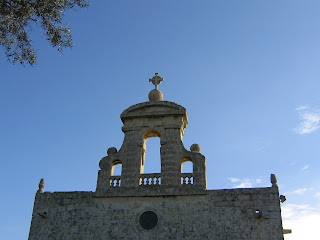
The medieval chapels are all characterised by a simple square construction with a belfry over the arched entrance.  The photo that heads the post is of the belfry at the first chapel we visited, Santa Marija ta' bir Miftuh, although the belfry here is a 16th century addition.  Inside there are lovely pointed arches supporting the roof of long stone slabs and on the rear wall the remnants of a mural showing the day of judgement.  Bir Miftuh, the location of the chapel, means an open well.

One of the interesting aspects of this chapel is the story of its restoration.  It is located quite close to the International Airport and they sponsored the restoration.   They have just removed the altar panel and it will be taken to a specially built glass room at the airport where the restoration will be carried out by experts in full view of travelers.  Some of the people on the tour this morning were disturbed that the holy artwork was to be removed from the chapel but the decision-makers argued that it was an excellent way of raising the profile of both sponsor and heritage site.  

For me, the restoration arrangement appears to be part of a wider culture of recycling and re-use in Malta.  Since medieval times, parts of the Bir Miftuh chapel have been torn down and used in other buildings such as the present parish church of Gudja.  In St Catherine's of Italy in Valletta, the huge altar panel by Mathew Pretti has been restored and moved to the Museum of Art so visitors can see it whilst the other restoration of the chapel proceeds.  And in Tas-Silg, the fourth chapel that we visited this morning, the medieval construction of the chapel re-used and re-cycled the prehistoric and the Roman buildings that were on the site.

The next two chapels we visited at Hal Millieri, were also built on Roman ruins and coins were uncovered in excavation.  The site is located in the centre of Malta's largest plain and we walked between well maintained fields to reach the chapel.  The immediate approach to one of the chapels, The Annunciation chapel, is down a lovely, walled laneway with trees and shrubs, an olive press and a well.  The most likely origin of the place name is the Sicilian family name of Millieri and there was a cluster of farmhouses and four churches known as a 'Casale' and grouped around a piazza.  For some reason, the population dwindled from about 1685 and the site was deserted by the 18th century. 

Stepping down inside the Annunciation chapel, the ceiling arches are pointed and the walls are made of rubble covered in plaster with medieval frescoes of 12 of the saints including two St Georges.  The style is a blend of high Byzantine and the beginning of Romanesque heralding the Renaissance.  St Agatha, for example, who is depicted together with St Blaise, is shown as very curvaceous with a pleated robe hanging over one shoulder.  The painter may have been a Sicilian by the name of "Garinu" as this signature was found below the surface of St Agatha.  I feel a warm sense of recognition every time I come across St Agatha since traveling down through Italy (see earlier posts) and I still need to research her story more deeply.

50 metres down the road is the chapel of St John the Evangelist, which has now been restored to the point where it has been handed back to the church to be used for worship.  It was newly built in 1640 but the site was mentioned in 1481 as a chapel.  The roof arches here are semicircular rather than pointed and there is a lovely arched doorway with a small window low down on one side.  This window was put in to allow people who had been excluded from the church by the inquisition to stay outside and still be part of the proceedings.

Outside the chapel there is a 17th century parish cross that apparently has been a target for vandals.  At one stage, two 4WDs were stopped in the act of trying to pull it down and our guide said ruefully that it is a target for anyone that shoots.  I sat for a while in the sun by the old parish cross and listened to a group of German and English people discussing youth, vandalism and boredom.  Then the guide started rounding us up to walk back to the bus and still pondering the issue I got up and started following some people who were already walking down the road.  We walked for some time, and it wasn't until we came to another chapel that I hadn't seen before that I started to notice the distance we had been walking and the fact that there was no-one else following me.  I had followed the wrong people!

I ran back through the country lanes, picked the correct fork near to the chapels we had visited and got to the bus park that was now minus a bus.  A man working in his garage told me they'd gone.  I was stuck - my bag with my mobile and my house keys was on the bus.  I started walking down the road towards a bus stop where I was vaguely planning to catch a regular bus to Marsaxlokk where I knew the last chapel on the schedule was located.  As I walked, a people mover with a large Italian family in it stopped - they had passed me earlier when I was running down the road - and although they couldn't speak much English and I can't speak Italian, we managed to share my experience and they offered to take me to Marsaxlokk where they were heading too.  They juggled some of the children around and managed to squeeze me in the back and off we went but we only got round the corner when one of the children signed "there's your bus".  They had turned round and were coming back for me!  So we also did a U-turn and followed the bus back to the drop-off point.  I felt very silly and once I had apologised profusely to everyone, I heard their story about how they had realised I wasn't on the bus and had tried to phone me but of course my mobile was on the bus too.

After that, the final visit to Tas-Silg was something of an anti-climax.  I had visited there before with David Trump and heard about the pre-history and the Italian excavation of the site.  This time, the working excavation had been covered by tarpaulins and some of the weeds were recently cut so it was easier to make out the general line of walls and colonnades.  It seems that as there were no reports emerging from the Italian work on the site, Tas-Silg will be taken over by Heritage Malta and the University of Malta are excavating a continuation of the site across the road.

Since Tas-Silg is on the hill overlooking Marsaxlokk, I decided to leave the bus there, making sure I let people know I was going so that they wouldn't have to come back for me a second time!  I walked down the hill and the Sunday market was still in full swing in spite of the threatening rain.  I finished my medieval chapels trip by buying a lovely potted poinsettia for my Christmas decorations!

Tuesday, December 2, 2008

The road to...


This will be a brief post to punctuate the rather long informational rants I keep slipping into.  I'm just lapping up everything that I can to do with Malta and the blog is a good way for me to process what I'm learning!

The length of Malta walk that I was hoping to go on this Saturday has been postponed until next year.  If it is early in the year before I leave sometime in April it will be a good way to pull together the map of Malta I have been building in my head.  I know that I will be returning to Malta but for the time being I have to continue around the world back to Australia before the end of May 2009.

This morning I sent my first Christmas cards and parcels and bought some watercolour postcards to use as cards.  I want to buy a couple of sets of the new Malta monopoly game that has just come out.  I have a couple of sampler bookmarks to complete in the Maltese bobbin lace class that I do on a Wednesday.  So this week is going to be for making a few simple Christmas arrangements.  This Sunday I go on my first Christmas oriented tour of medieval chapels with Heritage Malta and on Monday I have my first Christmas lunch with Malta Ramblers after another walk around Mgarr.

Monday, December 1, 2008

Rambling around Zebbieh


My first post for December!  I must organise myself to send my season's greetings by snail mail.  Already there are street decorations and Christmas cribs appearing around the villages and several of the cultural organisations that I've talked about in previous posts are running tours of crib displays and medieval churches.

This post is about a ramble around Zebbieh and Mgarr lead by Dr Gunter from Ramblers Malta.  When the bus driver put me off the bus at Zebbieh parish church, I wandered up a road where he had pointed even though I couldn't see the familiar dome I have come to expect in a church here.  I was early and so I dropped in to a busy bar at the top where locals were ordering pasta for lunch and I had coffee with a date slice.  The German woman who had got off the bus with me and was looking for Skorba temple also turned up there and we chatted for a while.  She was staying for a week at a hotel up near the Gozo ferry and was enjoying walking around the headlands in that area.  Malta in the winter is great for walking - cheaper hotel rates, cool temperatures and less crowded.

I got directions to the church from the woman behind the bar and crossed the road to find a modern church, recently built with massive curved buttresses.  In this era of declining church attendance, Malta remains strongly catholic and religion is a significant part of daily life.  Even on the buses, people often cross themselves as we set off and repeat the sign as we pass particular shrines along the way.

I was still early at the meeting place and had a chance to chat with the walk leader who was briefing himself on his walk notes using a book by David Trump, the archaeologist I had spent a week with a month or so ago.  The route for the walk took us past the temple of Skorba where David Trump had done most of his work in the 1950s and 60s.  It was the first time I had been there but we weren't able to go in.  We looked through the wire mesh fence at the jumble of massive slabs of globigerina limestone that now seems so familiar to me.  Gunter was keen to tell his stories about Grey Skorba and Red Skorba pottery but everyone else was keen to get walking particularly as a few drops of rain were threatening so we didn't linger long.  

We did a lovely three hour circular walk down through the valley past the wetland that features in the photo.  After the rain, there was running water in the stream and I was glad to see the kind of habitat that I leant about in the course I completed at Mosta the night before.  I didn't quite believe that such areas existed in dry, rocky, overbuilt Malta  and I love discovering these secret, hidden places that are made even more significant by their transitory nature.

The valley is named after the wild fennel that grows everywhere with its pungent aniseed smell.  I spotted lots of Holm oaks and carob trees but also plantations of eucalypts which looked lovely but I now know have been recognised as a threat to the endemic trees.  On the way back up through the valley we passed a huge quarry to cross a major road and a woman told me with pride that she had formed an NGO with other women in Mgarr where she lived, to grow thousands of native trees which they were planting around the quarry.  

When we got back to the more traditional church in Mgarr, I found the bus stop to wait for the Valletta bus.  Two other walkers were also going that way and we waited happily as the sun reddened the sky behind the lovely dome of the church. On the bus, I was greeted by the German woman, her face glowing from the excitement of her walk around the temples, Roman baths and out to the cliffs.   So four women from all parts of the world chatted in various languages, a French woman now living in Floriana, a Maltese woman from Zejtun, an Australian now living in Marsaxlokk and the German tourist who got off at Mosta to make her connection to the northern end of the island.  Another brief, magic encounter on a bus!

Friday, November 28, 2008

Around Siggiewi


I saw the ad in the Times of Malta for a new series of cultural tours launched by the Malta Council for Culture and the Arts.  I cut out the ad and it sat around on my kitchen table for a few days until I was going up to Valletta for the lunchtime concert at St Catherine's.  By then, it was past the Wednesday deadline for booking but I went down to the office in Republic street anyway to find out more about the programme.  When I walked in through the big doors that took up the whole street frontage of the converted townhouse of the office building, there was no-one at the reception desk so I wandered up the marble stairs and was greeted at the top of the stairs by a young man poking his head out of a door.  I explained why I was there.

"You're not too late," he exclaimed, "we've put on extra buses to cope with the demand and there are still a few places left on the last bus."  Another young man inside the office started telling me with enthusiasm that we were going to be shown around the inside of the PM's residence, "even the bedrooms!"

"I hope they won't still be in bed then," I muttered, wondering if I would regret putting my name down for what was starting to sound like a reality TV nightmare.  Anyway, I showed them my KartAnzjen that I have just received through the local council process using my Malta ID card and I got a reduced price.  Playing the old people's card here is magic and gets me 23 cent travel on any bus, anywhere.

So on Sunday, I got an early bus up to Valletta where I had to pick up the coach at the statue of Independence in Floriana.  When I arrived, there were six buses lined up and I was early enough to get on the first one.  Everyone else on the bus was Maltese and so the commentary was given in Malti.  Later, a friendly woman sitting next to me spoke to the guide about the fact that I couldn't speak Malti and she started to give two commentaries using both languages.  I continue to be humbled by this social skill that Maltese people have of slipping easily between the two languages.  But speaking Malti is still a symbol of Maltese pride and independence and it is the preferred language of everyday social interaction when everybody can speak it.  In my posts about the pre-history of Malta I talk about the continuing tension in choice of language between Malti, English and Italian.

First we visited Verdala palace.  There's a photo of the outside of the palace/castle heading up one of my earlier posts, and the photo that heads this one is of one of the amazing vaulted ceilings.  The ceilings and stairs were probably the most impressive aspect of this building that is now the residence of the PM and used for entertaining important visiting dignitaries.  Other rooms had very high ceilings with timber beams and the staircase was oval rather than circular and had lovely stone arches.

Next we went to two old churches in Siggiewi.  Providence church has a lovely domed ceiling and in the sacristy there is a red covered copy of a bible in Malti.  It is a small church and when we were all inside, it was a bit crowded so I didn't really take in much.  The other church we visited was medieval and has recently been restored with accolades from Din l-Art Helwa, a local NGO who are particularly concerned with Malta's heritage.  I loved the way it had been restored as a ruin rather than attempting to rebuild.  The ancient parish church had been pulled down to make way for a new church which was never built on this site.  Two interesting twisted Corinthian pillars have been reset on either side of an entrance into the old chapel where now stone carvings are on display.  To get to the site, we used a walkway through an old orange grove.

Our  final visit for the morning was to the Inquisitors Palace at Girgenti.  I have mentioned the Inquisitors palace at Birgu in a previous post.  The one at Girgenti was purely residential rather than also hosting the operations of the inquisition as it did in Birgu.  Nowadays it is the summer residence of the PM and I liked the use of the work of modern Maltese artists in the bedrooms.  For the most part, it is fairly austere as palaces go but the views down through the lovely valley are great.  When we came out of our tour into the garden, we were offered an enormous bread roll for lunch with a choice of 7-up or Coke which I devoured with relish as we walked back down the drive to our bus!

The idea behind this series of cultural tours is to enhance understanding of local culture and heritage.  It is particularly aimed at Malta residents rather than tourists and it gives access to sites that most tourists would not see.  The next tour in December is to Birgu with a trip across to Senglea in a traditional luzzu and I'm planning to book that before the deadline!

Wednesday, November 26, 2008

Because it's so small


One of the things I love about Malta is that it is small.  I don't need a car here because I can walk everywhere around the village.  Shopping is done every day so it's fresh and I can carry it easily by hand.  If I want to go further afield as I usually do several times a week, I can catch a bus to anywhere on the island.  If I take a book with me, or the Times of Malta that is saved for me most days by the local newsagent, then the unpredictable wait between buses is an opportunity.  So far, if I am pressured for time or I have to go home after the last bus leaves, I have been able to find someone with a car who is going in my direction.  It is a good system with the added satisfaction of reducing my footprint on the planet!

Another good thing about smallness is that it is easier to see the complexity of the links between everything that makes up the whole.  I seem to have moved into a space where I am avidly gathering all the information I can find about Malta.  The word 'Melitensia' has started to come up.  It means things to do with Malta.  The local librarian used it the other evening to describe my area of interest.  When I went slightly wild at the book fair in Valletta a couple of weeks ago and bought too many books on Maltese history and culture, one of the book stall owners used the word to encourage me to go to browse his shop collection.  So now I can put that label on my current interests.  

I use that as an example of a broader picture that is emerging for me.  I think it is to do with the cliche about thinking global but acting local.  As I gather the small, fascinating facts about Malta from many different sources in the course of my everyday life, I also seem to be gaining more of a gut understanding about global issues.  Another example is the final session last night of the course I have been doing in Mosta, 'Wildlife and Habitats of the Maltese Islands'.  The session was about legislation and was somewhat inclined towards long lists of conventions, agreements and decisions that have relevance for EU and for Malta.  Some things I had heard of before but in an academic sort of way - Bonn, Berne, Rio, Ramsar.  I had also heard words like ratification bandied around but hadn't really understood the significance.  Last night when the lecturer mentioned in passing that Malta had been taken to the EU court because it had failed to make enough progress in dealing with the issue of the hunting of migratory birds, I could link that in my mind with the gunshot that has woken me most mornings for the first few months here, the little hunting bird tables around most of the fields when I am walking, the local librarian talking about how her husband gets very depressed if he can't hunt, the pressures on the landscape of a small, crowded island.

Today I am going for another Ramblers walk, this time around Zebbiegh and Mgarr visiting the ancient temples of Skorba.  I started this post thinking I would talk about the cultural tour I went on last Sunday around Siggiewi but I got side-tracked by smallness.  So Siggiewi will head up my next post and for this one, I'll find a photo and post so that I allow enough time for the bus to Mgarr. 

PS  The photo was taken when I was exploring around Senglea, one of the ancient cities around Grand Harbour