Saturday, January 24, 2009

A rainy day in Valletta


Here in Malta we've had more heavy rain this week.  Today is sunny but still cold.  I've got my washing out on the roof but it is very windy and I think I just heard my drying rack get blown over.

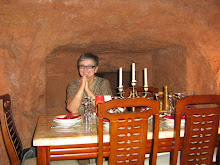
This post is about my day in Valletta on Thursday.  The photo was taken some time ago in the armoury in Valletta.

When I got off the bus at the terminus outside Valletta it had just started to rain.  When it rains hard in Malta, you start finding abandoned, fold-up umbrellas all over the streets because they just can't cope with both the wind and the rain.  I was glad of my sailing wet weather gear that I was wearing because my umbrella was hard to manage and started dripping on me very quickly.

Before the lunch time concert at St Catherine of Italy, I decided to duck into the water services office to find out about the new water/electricity bill I had just received.  It looked like they were charging me again for the first bill I had paid a couple of weeks ago.  This time, the office wasn't so crowded and I got attended to as soon as I took my number.  I had to wait for an hour last time!  It looks like the flurry of enquiries resulting from the raising of the tariffs has started to subside.  The young woman on the desk was as courteous as last time and quickly explained that they had made a mistake and when I go to pay (I have 45 days grace) I should let them know.

The concert at St Cat's was a programme I had heard before - Colour me... a spectrum of Baroque vocal music with Ramona Zammit Formosa on harpsichord and piano and the young soprano  Dorothy Baldacchino.  I learnt that the piece from the opera 'La Bella Molinara' by Giovanni Paisiello is about an old lady who regrets that she can no longer feel love!  Another song, 'Pursue thy conquest, love'  from Purcell's Dido and Aeneas, I already knew because some 30 years ago I choreographed a production of this opera at Townsville College of Advanced Education in Australia.  Dorothy sang it at an incredibly fast pace that left me breathless!

When I came out it was still raining and I hurried round the corner into the Auberge d'Italie to see an exhibition by Richard Saliba called 'Vanishing landscape'.  He has managed to capture the rural landscapes I have become familiar with as I walk through the valleys with Malta Ramblers.  The artist has a website www.richardsaliba.com

By then, it was time for lunch and I walked through the rain over to the Valletta band club on Republic street where I read the paper and enjoyed my rabbit with a glass of red wine.  By then, it was still raining and I still had a couple of hours before I was due at a travel agency to confirm my tour to Catania in the first week in April.  I couldn't quite remember where it was so I wandered off through the wet streets dropping in to a shop to buy some warm pyjamas that were on sale and lingering in the covered arcades.

By the time I was due at the agency, it was still raining and I hadn't found it so I asked two women who were hurrying through one of the streets parallel to Merchants street in Valletta's neat grid system with their umbrellas up.  They just happened to be going on the same tour as me so I accompanied them!  A charming old man from Gozo will be leading the tour and he offered to translate the brochure itinerary into English for me and post it.  It arrived this morning so I'm all set for February 2nd when I fly off for four days at the feast of St Agatha.


Tuesday, January 20, 2009

It-tanbur and il-flejguta


The photo was taken on the walk from Mellieha. 

This is a brief post about the tambour and Maltese flute I have ordered.  It-tanbur will be delivered this Thursday and il-flejguta sometime in the future.  A few months ago, I posted a blog about a Maltese composer, Ruben Zahra, that I went to hear at a lunchtime concert at Manoel Theatre in Valletta.  He introduced one of his pieces that used old Maltese folk instruments including a Maltese bagpipe. 

At the end of last year, I found Ruben Zahra's book, A guide to Maltese Folk Music and bought it as a Christmas treat to myself.  It has a CD of music included.

This year, I started to find articles in the local papers about Ruben Zahra's campaign to revive Maltese folk music.  He is running a programme in the schools and distributing tambours and flutes so that the children can learn to use them with the aid of CDs and their teachers who will attend a series of workshops.  There is a website with sound and video of an ancient Maltese tambour player, www.soundscapes.com.mt

So I emailed and am waiting for my delivery on Thursday!

Monday, January 19, 2009

Mdina, old city of Malta


It's bitterly cold today so I need to get out and walk to warm up!  

Yesterday I went on my second Council for the Arts and Culture tour, this time to Mdina, the old capital of Malta, also known as the silent city because you have to walk.  The city has been written about since the Phoenicians who noted that it was also occupied by the Carthaginians but there was almost certainly a prehistory to the Mdina plateau and hilltop.  It still is the home of several Maltese noble families.  The photo is of St Paul's catacombs which were our first port of call. 

The dead were kept apart from the living by putting burial sites outside the city gates.  We were dropped off from the special English-speaking bus (this was the first time the Council laid on an English-speaking guide) outside the Mdina gates and we had to walk through a winding Rabat road to get to the Catacomb entrance.  There is also a small catacomb beneath St Agatha's chapel further down the road and I made a note to visit there another time, perhaps when I get back from my trip to the feast of St Agatha in Catania.

The catacombs are a maze of interconnecting corridors between larger chambers and there are different kinds of burial plots, some on the floor but most on the sides or with vaults stretching away one after another into the distance as you can see in the photo.  The walls were washed in red and green but most of the pigment has disappeared.  When the Romans occupied the site, they kept the treasures and got rid of all the bones together with the DNA that might have yielded useful information today.  So we can only wonder at the painstaking work of quarrying out the social and burial areas.  The guide pointed out the ventilation shafts and we noticed the chimneys above ground when we came up.

There were three busloads of us on the tour, so you can imagine the juggling that had to go on to get us all through the confined spaces.  We stuck together in our groups and our guides tried to get us in and out without colliding with another group but it meant a bit of waiting around in between visits.  Our next visit was to the Mdina dungeons and as well as leading us back through the winding street to the Mdina gate, our guide briefed us on what to expect.  She suggested that if there were any children with a sensitive disposition, the parents should leave them for her to entertain above ground whilst the parents went down.  I wondered what horrors awaited me in the dungeons just inside the city gates.

In setting up the dungeons as a museum, the organisers gathered together all the nasty examples of torture, imprisonment and death in Malta and made life-size tableau in each of the cells to illustrate these horrors.  There is ample blood, chopped off heads and limbs, plague infestations, hangings and gunned down mutineers and patriots.  There is even a depiction of St Agatha with her torturer wielding the huge nutcrackers he is about to use to cut off her breast.  It seems the pre-Christian Romans were the nastiest of rulers and cut off any bit they thought was relevant to the crime before finally crucifying or burning.  But the Roman Inquisition, which was implemented in Malta rather than the Spanish version, was much more benign and only did a small amount of stretching, dropping from great heights whilst tied in nasty positions or strapping over a sharp, wooden horse with weights attached to the feet.

The Maltese people have valiantly managed a procession of colonisers until they finally gained their independence in the second half of the last century.  On the rare occasion when they rebelled without arms as they did after Napoleon sacked and looted the churches, the ring leaders were put in front of a firing squad and their end is bloodily depicted in one of the cells.

After this relentless procession of horror, it was a relief to find two cells occupied by knights who eventually became Grand Masters!  But by the time I got to them, I seemed to be alone in the dungeons so I hurriedly found my way out past the blood and gore and went into a palace next door to have my bread roll and orange juice that was included in the tour offering.

I sat on a doorstep in the sun by the Mdina gate until our guide started to round us up to go to our next adventure, the Domus Romana, just outside the gate.  As we walked over, I chatted with an Australian couple from Brisbane with their young son.  They had been traveling for a while through Egypt and Africa and were visiting relatives in Malta.  

I had had the difference between a domus and a villa explained to me somewhere before.  It seems that a villa is in the countryside whilst a domus is a townhouse.  Since the old city in Roman times extended much more widely than the current walled city, Villa Romana, which is what it was called when I was in Malta as a girl, became Domus Romana.  We had to wait outside the Domus until another group went through and I chatted with a Maltese woman who turned out to be a real estate agent about the rental market in Malta at present.  It seems that 2009 will be a good year to buy!

The most significant aspect of the domus still visible are the mosaic floors.  One has an interesting 3D effect and another has the bowl with twin doves as the centre piece.  After my experiences in Libya, the remaining pieces of Roman statuary were unremarkable.  How blase I have become!  Archaeologists assume that there are more Roman remains under the Moorish burial site behind the domus, but they are reluctant to destroy the site to find out.  Layers on layers!

We had another short wait outside the domus for our train ride which was the culmination of the tour.  I decided to go in search of coffee and found a tiny, dark bar around the corner where cheesecakes had just come out of the oven.  There was a queue and by the time I got my take-away coffee and cheesecake, the train had arrived and people were starting to get in.  I had to gulp down my coffee and put the hot cheesecake in my pack as it was forbidden on board.  The road train is a new offering and it takes a route around the Mdina hill through Mtarfa and back up to the city gate.  It is interesting to do it once and it gave me the opportunity to chat with an Englishman who has a house in Zurrieq which his family visits from time to time.  He encouraged me to put my name down for the Victoria Lines walk that Malta Ramblers are planning in a few months time.  It is described as a rugged, all-day walk and I wasn't sure if I could manage it but it seems it is well worth it.

On the tour bus back to Valletta I made a mental list of some of the things I need to return to Mdina for.  These include St Agatha's chapel and catacombs, a craft shop that I was introduced to at the lace-making exhibition, and another shop that apparently still sells Malta weave that I was beginning to think was no longer made in Malta.


Sunday, January 18, 2009

Mellieha to Selmun


This has been another catch-up week.  I managed to do some writing, got my hair cut, went and had another look at a townhouse in Birgu, bought a gas heater although it's taking me longer to organise the gas bottle to go in it and did my laundry on the first sunny day for a week.  Yesterday and today have been fine, sunny days and I've been out and about for the weekend.  The photo is of wild flowers on the garigue between Mellieha and Selmun where I went walking yesterday with Malta Geographical.  That's what this post is about.  In my next post, I'll write about the Department of Arts and Culture tour to Mdina that I've just returned from.

Malta Geographical tours start with a bus pick-up from Valletta.  Yesterday there were two bus loads and more than 100 people set off on the walk.  Unlike Ramblers Malta, there is very little commentary on Malta Geographical walks and so I'm a bit hazy about where we actually started from and what we saw en route!  But we started out from a newly built up area at the top of the ridge before going down into Mellieha bay and we walked out along the cliff at the southern end of the entrance to the bay.  The garigue looks great - very green after a week's rain and the wild fennel which has looked dead up until now has sent out lovely green fronds.

When we turned off the country road onto the garigue path, we walked along a fault line valley that has been used for beehives for centuries.  We walked past honey hive holes carved into the rock face alongside neat doorways into cave dwellings where the honey gatherers must have stayed when they were collecting. 

We followed a kind of zig zag way out along the edge of Mellieha with great views to Gozo, back through honey valley and then out again to a small bay that is used for swimming in summer.  Yesterday, a group of off-road bike riders were making the most of the mud to ride their bikes up and down the edge of the embankment and the eroded carpark.  There were also some people camping there.  The terraces all round were lush and green and it was here that I took the photo above.

We walked back inland and then out again through fields with dry stone walls and tomato canes, then climbed steeply up through a tiny old hamlet.  At the top, we again walked along the ridge of the garigue to a collapsed tower on the headland.  This had formed part of the knights' early warning fortification system but had collapsed in the great earthquake whose date I can't remember.

Not surprisingly, the views from here are great - north to Gozo and south to St Paul's island with its huge statue.  The headland before St Paul's island is a good example of the green clay  that makes up one of the layers of Malta's geology but is rarely exposed to the extent it is here.

 Again, we walked back inland along a country road with views to St Paul's bay over Anchor Bay and what looked like a sewage treatment plant on the top of a ridge.  We arrived at Selmun Palace where our bus was waiting to take us back to Valletta.  The walk was about 3 hours and again it was an area that I hadn't explored before so another fragment of Malta fell into place.

Tuesday, January 13, 2009

Two days in Valletta


I spent most of the weekend in and around Valletta.  The photo was taken some time ago on the dhajsa crossing from Birgu to Valletta.

On Saturday, I caught the bus up so that I could go to a travel agent to confirm my four day trip to Catania at the start of February for the feast of St Agatha.  I have mentioned in previous posts that I have become interested in this saint who died so horribly. The advertised trip seemed a good opportunity to find out more about her.  The brochure is in Malti and all the other people on the trip are Maltese, so I'm not entirely sure what we will be doing, but the guide assures me that there will be English spoken on the four excursions we will be going on.

After I found the agency in St Paul street, I decided to visit some of the art shows on in January.  Joseph Farrugia's show, Contemporary Icons, is at St James Cavalier.  He seems to be exploring images of paper planes and the clothes people wear - sometimes the folds of paper planes are embedded in a jacket hanging on a coat hanger.  Strange.

Isabelle Borg's show, Strange Cargo, is at the Museum of Fine Arts.  I particularly liked her portraits on the inside of suitcases.

On Sunday, I got the bus up again, this time to go to my first concert for 2009 at St Catherine of Italy.  The St James consort performed two concertos by J.S.Bach.  As usual, it was an excellent concert but this time it had been sponsored by the Zarb family to celebrate a 50th wedding anniversary so the front two rows of seats were reserved.  I felt quite deprived because I wasn't privileged to sit on the front row and feel connected to every string and key and valve in the ensemble!

I left hurriedly at the end of the concert because I was invited for Sunday lunch at my cousin's in Sliema and I planned to get the ferry across.  I cut across and down to the ferry landing to find that the ferry had been cancelled.  I hadn't noticed how strongly the wind had got up and it has been blowing ever since with plenty of rain.  Today, the sun has come out, but the prediction is for strong winds until Thursday.

In spite of having to hurry back up the steep, stepped streets to the bus terminus to catch the bus to Sliema which was crowded, I still arrived at my cousin's in plenty of time before the Maltese pasta was served but had to leave again soon after 2.00 pm to get back up to Valletta for 3.00.  I was booked to go to the matinee of Swan Lake on Ice being staged at the Mediterranean Conference centre down at the bottom end of Valletta some 15 mins walk from the bus terminal.  I found my seat in a box at the back corner of the theatre and settled into the rather cramped space that was in a great position to watch the full house come in and take their seats.  

When the show started, I enjoyed the flowing, gliding choreography of the ice-skaters.  Somehow, the moves and patterns of ballet work better on skates than on block shoes and the costumes were lovely!  But the drama and pathos of the show didn't really come across and I was disappointed with the dismembered black swan (the hunting crossbow seems to have been abandoned).  It also seemed to be a rather facile ending without anything that resembled a dying swan.  The pampered prince lives happily ever after with his own little swan after ripping the wing off an endangered black swan.

Yesterday I was out again - invited for morning coffee in Fgura with the parents of the local librarian who has introduced me to so many useful Melitensia references.  They have a spacious house with an orange tree and well in the courtyard and a mural of a tree on their dining room wall.  I enjoyed chatting about Malta and their impressions of Australia where they had all lived for several years.  I was also interested to hear that some Maltese houses have their plumbing linked into their wells to minimise dependence on Government water.  Many thanks to you all!

I got dropped off at Birgu afterwards to keep in touch with the 3 cities property situation for when I return in 2010 but the wind was too strong to get a dhajsa crossing to Valletta so I got a bus to Paola where I bought an Aroncini at the kiosk in the square and then the Marsaxlokk bus home.  

Friday, January 9, 2009

Ghar Lapsi


The photo is of the Valletta bus waiting outside one of the three churches that surround the square in Siggiewi.  This is where I had to get off to walk down to Ghar Lapsi because the buses only run there during tourist high season.  I had to walk down the road to the left of the church.  

As I was taking the photo, a Siggiwin (someone who comes from Siggiewi), walking through the square, stopped and said to me "You look like a happy person."  It was a great way to start a conversation!  Like many Maltese, he had lived in Australia for some years and was glad to talk to someone from those parts.  I have noticed that I present myself primarily as Australian here, even though my British passport makes it easier for me to travel in and out and settle in Malta.  After chatting for a few minutes, the inevitable question came up, "Is your husband with you?"

"I have no husband," I said, hoping that the unspoken "and I am not looking for one because that is why I look like a happy person" was understood.  He then invited me for coffee at his house just off the square and when I responded that I needed to start walking as I was due in Ghar Lapsi at 2.00pm, he offered to give me a lift.  By now I was pretty focused on my intention, so I declined the offer as politely as I could and we parted as friends with a vague hope that we would meet again someday.  As I set off to Ghar Lapsi, I thought about how many Maltese people present themselves as very friendly and open to visitors from other parts of the world.  It makes Malta a welcoming place for tourists and overseas residents but I'm not sure to what extent 'foreigners' are allowed more deeply into the Maltese culture where people seem to argue and joke with each other very passionately.  Perhaps I have to learn the language to find out about that.

By this time, I had walked through the outskirts of the town of Siggiewi and was heading towards Ghar Lapsi on a major road lined by high rubble walls.  I was starting to worry about getting to the Ramblers Malta meeting place at the old police station in Ghar Lapsi on time when a car pulled up and a woman leaned out to ask if I wanted a lift - it was two women on their way to join the walk so I accepted with gratitude.

In my library book on Malta's Southern villages, Siggiewi is described as a town on three levels, hills, plains and coast.  The Ramblers' walk was planned to take us up from Ghar Lapsi down at the coastal level up the magnificent cliffs to the plain where the town is built and most people live and then on a circular route back down to the coast.  Ghar Lapsi is a tiny fishing village at the base of the cliffs with a series of caves, some used as boathouses, others collapsed into the sea to continue the work of cove building.  Like most Maltese place names, there could be more than one derivation.  Ghar means cave (as in Ghar Dalem in one of my earlier posts) but Lapsi could be a corruption of Habsi, an escaped prisoner who hid in the cave or the Greek word, lapsi, which stands for Christ's ascension to heaven on the 40th day of Easter, a Thursday.

Because of my lift, I arrived in Ghar Lapsi with half an hour to spare so decided to go into the local restaurant/bar to get some lunch.  As I was waiting for my spaghetti with rabbit sauce, I found myself chatting to a woman whose story was very similar to mine.  Her mother was Maltese and her father was in the navy; she had spent some of her childhood in Malta and had been visiting for over 30 years.  This time, she was visiting with her husband staying at Ramla bay and had come to Ghar Lapsi for the wild flowers.  It seems it is still a bit early for the full wild flower display but I had noticed on the way down that there was plenty of heather in purple bloom and I have been noticing other flowers ever since we started getting rain at the start of the winter in November.  I now have quite a collection of wild flower photos which I'll have to collate for my friend, Carol, in Australia.

So, all this had happened even before we set off on the walk!  By 2.00, most people had gathered across the road from the police station and Dr Gunter led us off but first we just went to the left hand side of the village where we had a good view of the collapsed cave that gave Ghar Lapsi its name.  This remains a popular swimming cove in the summer, but people have to be cautious of the rocks scattered under water.  Yesterday, there was a strong swell running and I would also have been wary of being swept onto the rocks. 

We walked back through the village, past the Reverse Osmosis plant that has been built here to help with Malta's growing water shortage, past a solitary castle/house built on the rocky garigue,  and on up the road past a deep gorge plunging to the sea below.  Geologically,  this area is important because it demonstrates clearly the layering of the rock that makes up Malta as well as the massive folding of the earth that has pushed up the Maltese archipelago and the mountain peaks between North Africa and the Alps.

Shortly after the gorge we left the main road and started up a country lane with irrigated fields and high stone rubble walls on either side.  In the Times of Malta that morning there had been a short article about the government demolition of a high stone wall somewhere in this area.  It seems it has become common to build up the usual waist high rubble walls to a height higher than human.  Several people, including the Ramblers Malta Association, have complained that this is altering the nature of the rural landscape and it seems that the government are starting to take notice.  This first demolition using a bull dozer had to have police in attendance because the farmer, who had been notified of the intention, was protesting strongly.  This kind of scenario is being played out in different ways as government organisations try to regain control of public space where individuals have traditionally stamped their own dreams and endeavours onto the landscape.  This has given us the amazing array of shrines and chapels that dot the rural areas, the great street cafes and restaurants in the built up areas, the lovely rubble walls that surround the fields and country lanes.  But it has also enabled some abuse of public space and now the government is finding it hard to establish policy to prevent that.

The country lane narrowed and it became difficult to walk up an overgrown stretch that appeared to be used as an irrigation ditch.  When it opened out again, we were walking along a flat stretch at the base of the cliffs reaching up to the Gebel Ciantar plateau that has Siggiewi, Rabat and Dingli on the edges.  We came to a tiny hamlet that has two chapels; Tal Lunzjata is a familiar medieval chapel and further on Ta-kammnu has a fascinating history.  It was built over a spring by the noble lady Gebel Ciantar who gave her name to the plateau above.  The spring dried up, and Gebel Ciantar prayed to Our Lady and made a vow that if the water started running again she would dedicate a chapel.  When the water came in again a few years later, the lady kept her promise.  She later presented the chapel to the safe-keeping of the religious order associated with the chapel of St Paul shipwrecked in Valletta.  This is why there are excellent records of the development of the chapel and it is very well maintained.  It also explains the milestone nearby saying Miles to Valletta.  The number of miles has been erased, probably in WW2, to avoid giving useful information to an invading force.

After the hamlet, we started in earnest up the rocky path to take us up the cliff.  It was very steep despite the hairpins and many of us were breathing heavily as we came up to the top and gasped at the stunning views of the Dingli cliffs to the North and Ghar Lapsi to the South.  Right at the top we passed a high rubble wall that I realised had letters built into the wall using quarry stones amid the rubble.  I tried to work out the word that had N, A, Z, I, and C, I think, but one of the local people said that it was just advertising for some kind of battery!

The pace quickened as we walked along an old Roman road because our leader had realised that we were running out of time to get back to Ghar Lapsi before it was dark.  As we got back onto more established country lanes, we passed the Madonna tal-Girgenti, where someone had seen a vision that inspired the large outdoor seating area for people to contemplate the three statues and the trough where running spring water still comes out.  Several walkers renewed their bottled water from the spring.  

We also passed the Girgenti palace that I had visited before with a Malta Heritage tour (see one of my previous posts).  The orange trees in the valley were heavy with ripe fruit.  Soon after, we came closer to Siggiewi before turning towards Ghar Lapsi and I decided to leave the main group and head towards Siggiewi to get the bus back to Valletta.  It was getting dark as I walked into the main square and a bus was waiting for me.  What a rich day!

Wednesday, January 7, 2009

2009 settles in


Today we started back at the lace-making class and I have fish bones on the stove for soup, so the routines are returning.  The photo is of the lane down to Marsaxlokk from Delimara.

This week I also started planning the stopovers on my trip back to Oz and anticipating visits from friends and relatives before I leave Malta for the time being in the middle of April.  I went up to Valletta yesterday and booked two of the Department of Culture and the Arts tours for this month and next.  I also managed to get one of the remaining seats for Swan Lake on Ice with the St Petersburg State company which is on this Sunday at the Mediterranean conference centre.  It's not the kind of event I would normally seek out, but it just seems such a strange combination of art forms and venue that I decided the opportunity should not be missed!

I caught another bus from Valletta down to Msida where I wanted to seek out Amphora travel who are advertising special Egypt tours.  I eventually found them halfway up Testaferatta street which runs over the ridge between Msida and the Sliema front.  A very helpful woman worked with me on planning the first two stopovers of my return journey.  I now have a pile of brochures on Cairo, the Nile cruises and Sharm el Sheikh on the Red Sea as well as some more details on Dubai and Oman to add to my two guides.  When I set off in April, I'll be spending about 10 days in Egypt and then 6 days in Dubai/Oman before traveling on to Singapore.

It's shaping up to be another full year!