Something about the North West of a region seems to bring out the more rugged, wild side. I was born on an island on the wild West coast of Scotland; in the North West of Australia I have traveled through the dramatic landscape of the Kimberley; in the North West of Tasmania, I have been humbled by the Tarkine wilderness area, that is now under threat.
Malta is a tiny island, heavily developed with an ancient history of human influence, yet the North West retains something of the natural landscape and boasts the first of Malta's National Parks, il Majjestral. This is the area that the Malta Ramblers chose for their weekend pre-Christmas retreat this year.
Alex Vella and Sam Grech had laid on a full programme for us. I am not used to the luxury of having someone else make all arrangements for me and I really enjoyed falling in with the group for a whole weekend. If I had twinges of conscience about staying at a luxury hotel that intrudes outrageously on the landscape, my misgivings were assuaged by the fascinating natural and cultural resources we were able to access readily from such a base.
I missed out on the first walk on Friday afternoon because there was too much happening at home, the bus route between Valletta and Golden Bay is tortuously slow and I was unsure about how my recently sprained ankle would deal with what promised to be a difficult walk. The route led along the Westerly cliff of the park and dipped down into the boulder strewn drop-off below the fault line that forms the cliffs. For now, I have to content myself with looking down on this rich terrain from the garigue above. I have attended an excellent lecture by Analise Falzon, Parks Ranger, in which she discussed how the tumbled, boulder strewn areas below the cliff edge becomes a protected habitat for a variety of flora and fauna. The park area also extends out into the sea.
I arrived at the hotel on Friday evening in time to be stunned by the magnificent sunset view over Golden Bay to the Ghan Tuffieha headland. It was a dramatic cocktail before finding my way down for the first of our indulgent buffet dinners. There is something about being in a large group of people that gives us all permission to eat far more than we need. Perhaps it is a deep memory of more ancient times when clans and communities would come together to celebrate a successful hunt in a lean season or fatten up before an anticipated period of scarcity. Whatever the excuse, it was a great way to mellow out before the quiz night that had been planned for us by the unstoppable Sam.
Saturday was planned as a full day of walks and visits that we could drop out of at several points during the day if we wanted an early return to the hotel. First we walked to the Elysium, a plant nursery run by the GAIA foundation where Maltese native flowers, shrubs and trees are reared from seed to be planted around the island. This was a great opportunity for me. I came away with an enormous list of possible plants for my dream roof garden.
The groundswell of public opinion in favour of preserving and extending the cultivation of endemic species is now supported by the development of nurseries such as Elysium. I am hopeful that it won't be too long before roundabouts and public gardens will boast collections of garigue and endemic plants. I recall when I lived in Redlandshire, south of Brisbane in Australia, the local council ran a native plant nursery where they had laid out examples of private gardens using only endemic species. Local people were enabled to consider how to develop their own gardens using endemic plants rather than exotics.
From the nursery, we walked up over garigue paths past Ghan Tuffieha bay where my father painted a water colour of the bay sixty years ago. The old hotel that must have been operating in those days is now abandoned and falling into ruin awaiting permits to develop. I am hopeful that the unpredictability of the terrain in that area and a changing climate about over development of tourist sites will prevent that from happening.
From there, we followed paths and country roads until we arrived at Zebbiegh where we paused for lunch. Very few of us felt like eating after an over-indulgent buffet breakfast. Some decided that the morning's walk had been enough for them and caught a bus back to the hotel. My ankle had felt vulnerable on the garigue and I was grateful to another Rambler who arranged for her husband to meet us at Zebbiegh with a stick for me to use.
The lunch stop was close to the Skorba temple which was our first afternoon visit. I have walked past the site several times and have read about it in the archeological books I have on my shelves but this was the first time I was able to enter the site with a knowledgeable guide. The site is quite small and bounded by more recent development but nevertheless is very significant in terms of a fuller understanding of the temple building era.
The site at Ta Hagrat in Mgarr which was our second visit is no bigger than Skorba but the familiar layout of circular apses is more readable. The site is unique in having steps leading up to the main entrance.
I was tired as we completed our tour of the two temples and was happy to catch a bus back to the hotel along with several other members of the group including our leader, Alex! The remaining members walked back along the cliffs to join us at another over indulgent buffet dinner followed by a quiz night.
On our last day we were scheduled to walk through il Majjestral National Park accompanied by leading naturalist, Analise Falzon. We met up with her at the entrance to the old British barracks which have recently been handed over to the Parks administration. As we walked up through the barracks we were treated to a first-hand glimpse of the tensions that needed to be negotiated between Parks administration and habitual users of the area.
During our initial briefing, several off-road vehicles roared past us and Analise explained how signs or closed gates usually had a life-span of less than one week before being ripped down or vandalised. Traditional hunters and fishers also expected to have parking areas as close as possible to their hunting or fishing spots. Even family picnicking puts unexpected demands on the park administration. One family arrived and established themselves in one of the buildings of the barracks as though it was their own weekender and another family who were using the electronic vehicle track assumed a right to start a BBQ fire using sparse garigue wood.
It will be a long road to establish a shift in patterns of useage for the park. Organisations such as the Ramblers have a role to play in modeling appropriate behaviour and we have also undertaken to help with some clean up work in 2012 but it will require a lot of good will on the part of government and NGOs before we begin to see a shift from a culture of exploitation to one of nurturance.
Once we got out onto the garigue, it was most clearly the culture of nurturance that Analise was able to demonstrate as she stopped us by rich groupings of flora and explained to us the diversity of plants that grew in the various habitats generated by geological processes.
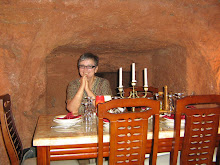
The walk finished at the Manikata medieval farming community at the edge of the park where we had a rustic lunch. This area is now managed by a co-operative of local farmers who have done a great job restoring the old dwellings, caves, apiaries and gardens. By this time, the scheduled short morning walk had extended well into the afternoon and I was happy for the offer of a lift back to Sliema where I would find more frequent buses to Valletta and home.
It was a great weekend that left me pondering several of the dilemmas and contradictions associated with the task of moving from a culture of exploitation and over-development to one of nurturance and conservation. Development such as the luxury hotel at which we stayed cannot now be reversed but perhaps we can find ways of enabling the man-made to support and nurture the recovery of the natural and we can certainly be more careful in granting permits for further development. Some cultural practices exploit and damage the natural environment and it will be difficult to shift these patterns unless we can show that there is real joy in cherishing what we have left and this legacy is the right and responsibility of all.